name: base layout: true .footnote[GIScience I, Spring 2017] --- class: inverse, middle # Lecture 4: Coordinate systems and projections --- ## GIS as process 1. Locate entities in the world. 2. **Represent the entities digitally.** 3. Describe the entities. 4. Process, integrate, analyze. 5. Communicate the results. 6. Audience: Interpret, make decisions, give feedback. --- ## Coordinate system A system for georeferencing used to represent locations by their position in *geometric* space. Coordinate systems are made up of the following components: 1. A measurement framework. 2. Units of measurement. 3. A representative model of the Earth (ellipsoid). 4. A set of control points with known geometric relationship to the reference ellipsoid (datum). * A 'geographic' coordinate system has a measurement framework with coordinates that measure angles from the Earth's center. * A 'projected' coordinate system is one where the measurement framework represents a conversion of the spherical location to a 'planimetric' (flat) location. * In this case, we should include a fifth component to these coordinate systems: a projection. But first, let's consider geographic coordinate systems. --- ## Measurement framework: longitude/latitude * Outer boundary of plane through the center that lies perpendicular to Earth's rotational axis is the *equator*. * Outer boundary of a parallel plane a given distance from the equator is called a *parallel*. * Points on a parallel share the same latitude. * Distance of degrees between parallells is constant: 111.321 km per degree. * Outer boundary of a plane that includes the rotational axis is a *meridian*. * Points on a meridian share the same longitude. * Distance of degrees between meridians is **not** constant. * [video](https://www.youtube.com/watch?v=MjDqhLUzCpE) .image-60[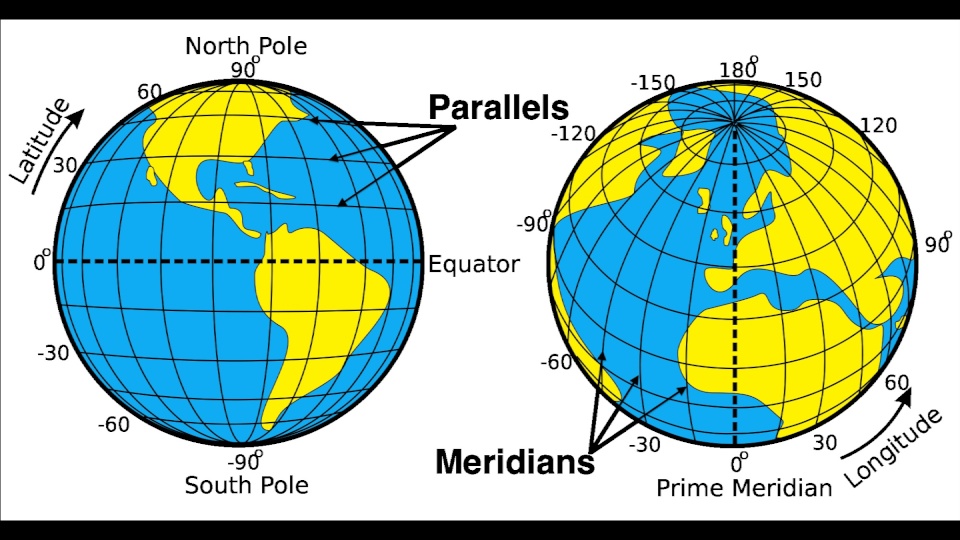] ??? * Meridian distance: there are ways, involves trignometry. --- ## Units of measurement: Degrees * Historically, common to record as `Degrees, Minutes, Seconds` of angle. * `123° 42' 20" W, 44° 0' 22" N` * Called *sexagismal* (60-based). Used in angles, times. * More common today to use `Decimal Degrees`. * `-123.7056°, 44.00611°` * Notice DD often uses negative for W/S, treating 0°, 0° as a graph axis. * Convert DMS to DD: degrees + minutes/60 + seconds/3600 --- ## Shape of the Earth * Defining meridians and parallels by the rotational axis allows us to apply them to any rotating object, no matter the shape. * Convenient, since the Earth is not a perfect sphere. .left-column[ .image-100[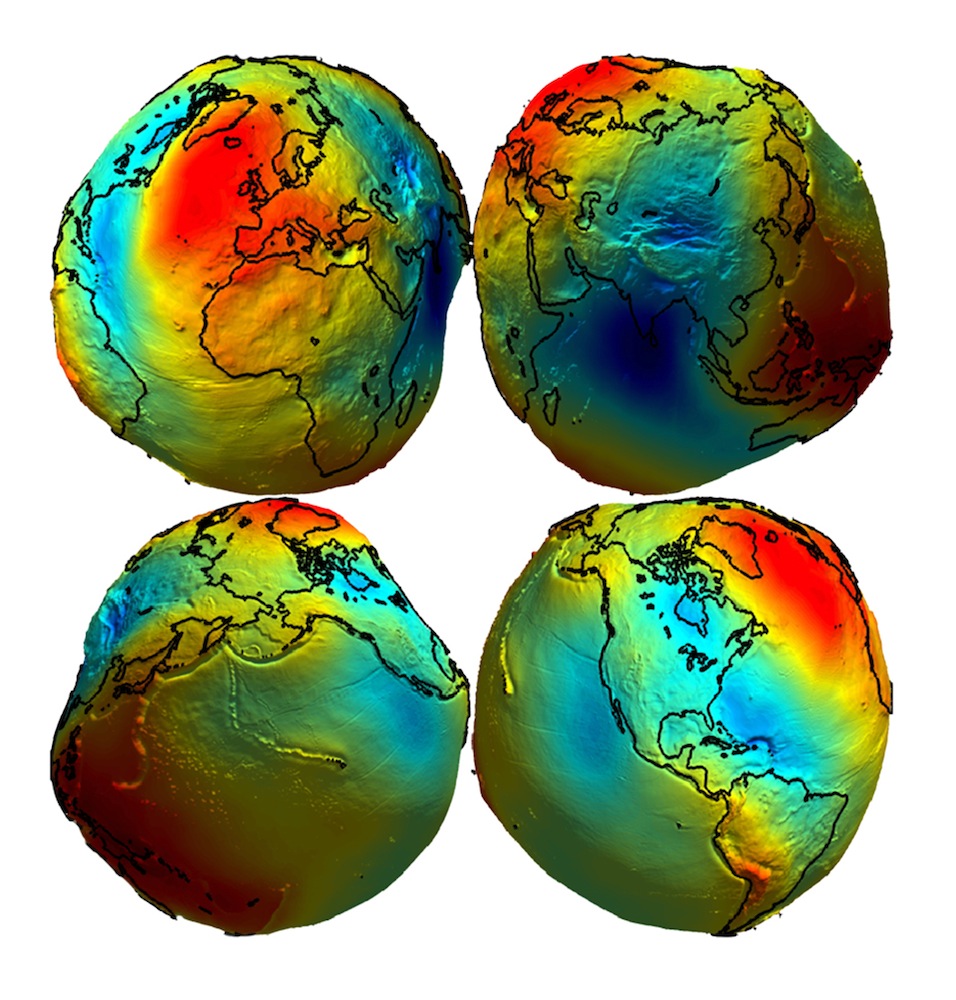] (heights exaggerated) ] .right-column[ * Bumpy, complex irregular shape called a *geoid*. * Bulges around the equator; flattened at the poles - caused by centrifugal forces acting on planet's mass. * Earth's mass is not distributed evenly, so bumpy. * Fun fact: without things like tides, currents, salinity, air pressure, etc. water would cover everything blue in image. ] --- ## Representative model: Ellipsoid Difficult to define coordinates like longitude/latitude on a geoid, though. To simplify calculations, it's better to use an idealized mathematical representation of the geoid. * Ellipsoid (spheroid). .image-80[] --- ## Control Points: Datum From these control points, we can find distance, area, direction between locations on the Earth. * Amazingly, ellipsoids can vary quite a bit. * Advances in math & measuring the Earth's mass/shape. * Newer ones are pretty similar. * Datums do get minor updates (can't stop plate tectonics). * Datum shift: the slight variation when converting between datums. * Important to not forget when using data with different datums. 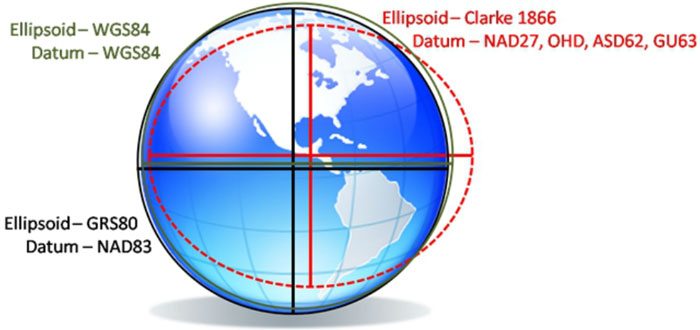 ??? * Technically, the datum is the combination of the reference ellipsoid and the control points. * Big ones around here: WGS84 (all GPS), NAD83 + derivatives (most gov). --- ## Projections Why flatten the Earth? * Common mediums of storage are flat: paper, equal grids (field), photos. * Convenience: easy to conceptualize and **see**; geometry vs. trignometry. * Historic data collection methods used local flatness for location: surveying, etc. A projection is the mathematical transformation converting spherical coordinate (longitude/latitude) to a flat *cartesian* coordinate system- --- ## Projections by surface  ??? * Planar also commonly called *Azimuthal*. * Not going to get into, but there are hybrids and other funky surface types. --- ## Projections by preserved property Most projections minimize distortion of a geometric property. * Conformal: Preserves angles (general shape). * Equal-area: Preserves area. * Equidistant: Preserves distance from fixed point or line. * Retroazimuthal: Preserves direction from fixed location. * Gnomonic: Preserves no property - converts great circles to straight lines. * Great circle: Outer edge of a plane that passes through the center of a sphere. * Great circle section between any two points is the shortest path of travel. * 'Compromise': Preserves no one property - balances between distortions. --- ## In-class activity: Comparing projections * Put your name (including last) on a piece of paper. * For each of the upcoming projection examples, write the following information as we discuss them in class 1. Projection name. 2. Describe the shape of the graticule (the lines of parallels and meridians). Squared? Divergent? Curved? Meridians meet at poles?. 3. Why use this projection? All images are from Wikipedia, which has some of the best explanations for projections. --- ## Conformal: Lambert conformal conic .image-90[] ??? 1. Lambert conformal conic. 2. Not parallel, but meet at north pole and fan out at consistent angles. 3. Lines approximate great circles at short enough distances. * Aeronautical charts. * Common in government-specified projected coordinate systems: US State Plane, India, EU/INSPIRE. --- ## Conformal: Mercator (cylindrical) .image-90[] ??? 1. Mercator (cylindrical). 2. Parallel, do not meet at poles. 3. Lines have constant bearing/direction: good for navigation. * Transverse Mercator: rotates the cylinder 90 degrees. High accuracy measurements when within a few degrees of parallel + constant bearing. --- ## Equal-area: Goode homolosine (pseudocylindrical) .image-90[] ??? 1. Goode homolosine (pseudocylindrical). 2. Not parallel, meet at poles. 3. Actually two different projections in midlatitudes (Sinusoidal) and at poles (Mollweide). * Avoids increasing distortion away from the reference lines. * Excellent area preservation makes good do distribution maps. --- ## Equidistant: Azimuthal equidistant (planar) .image-90[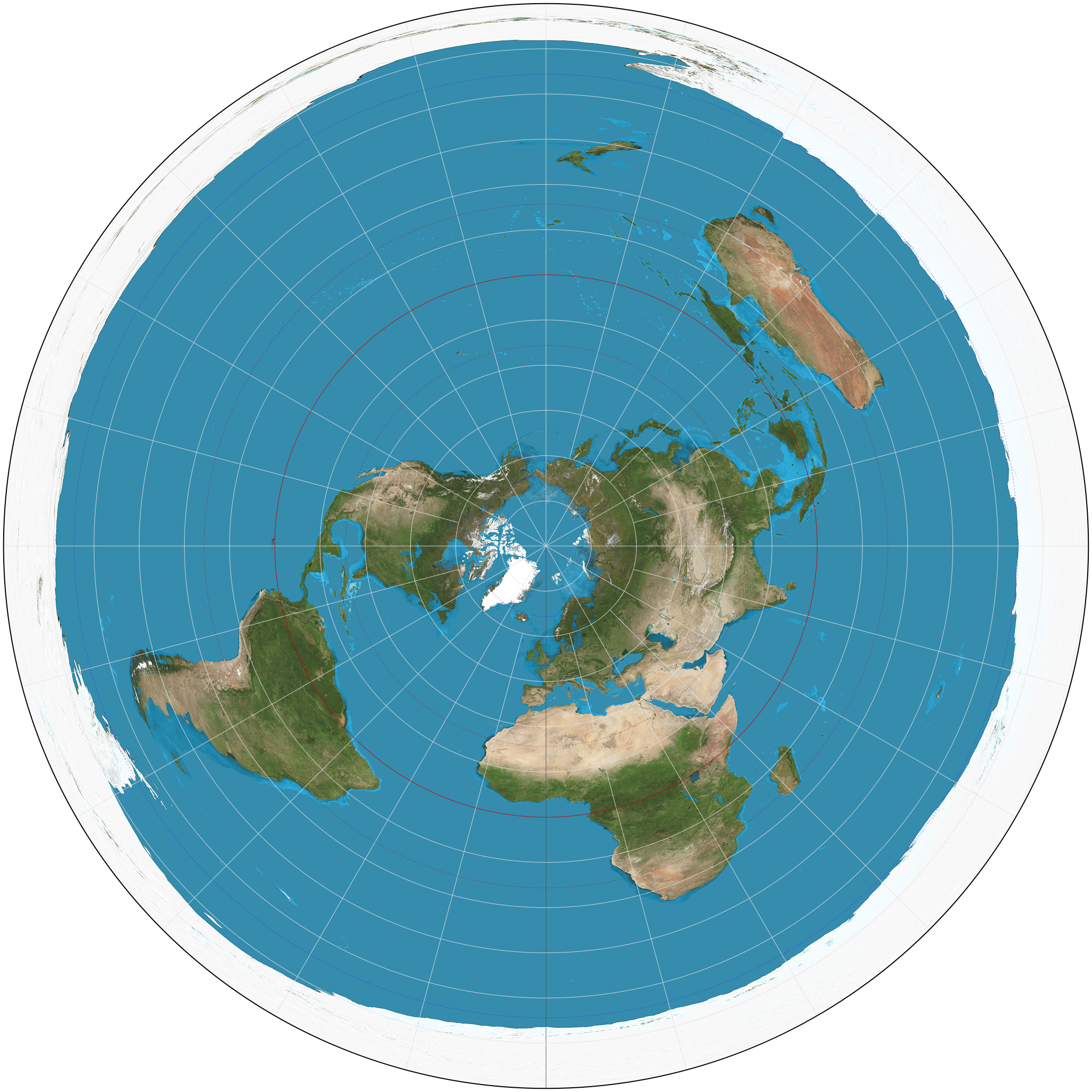] ??? 1. Azimuthal equidistant (planar). 2. Not parallel, but fan out at equal angles; meet at pole that's showing. 3. Useful for showing distances from a point of interest. Also... --- ## Equidistant: Azimuthal equidistant (planar)  --- ## Retroazimuthal: Craig retroazimuthal (planar) .image-90[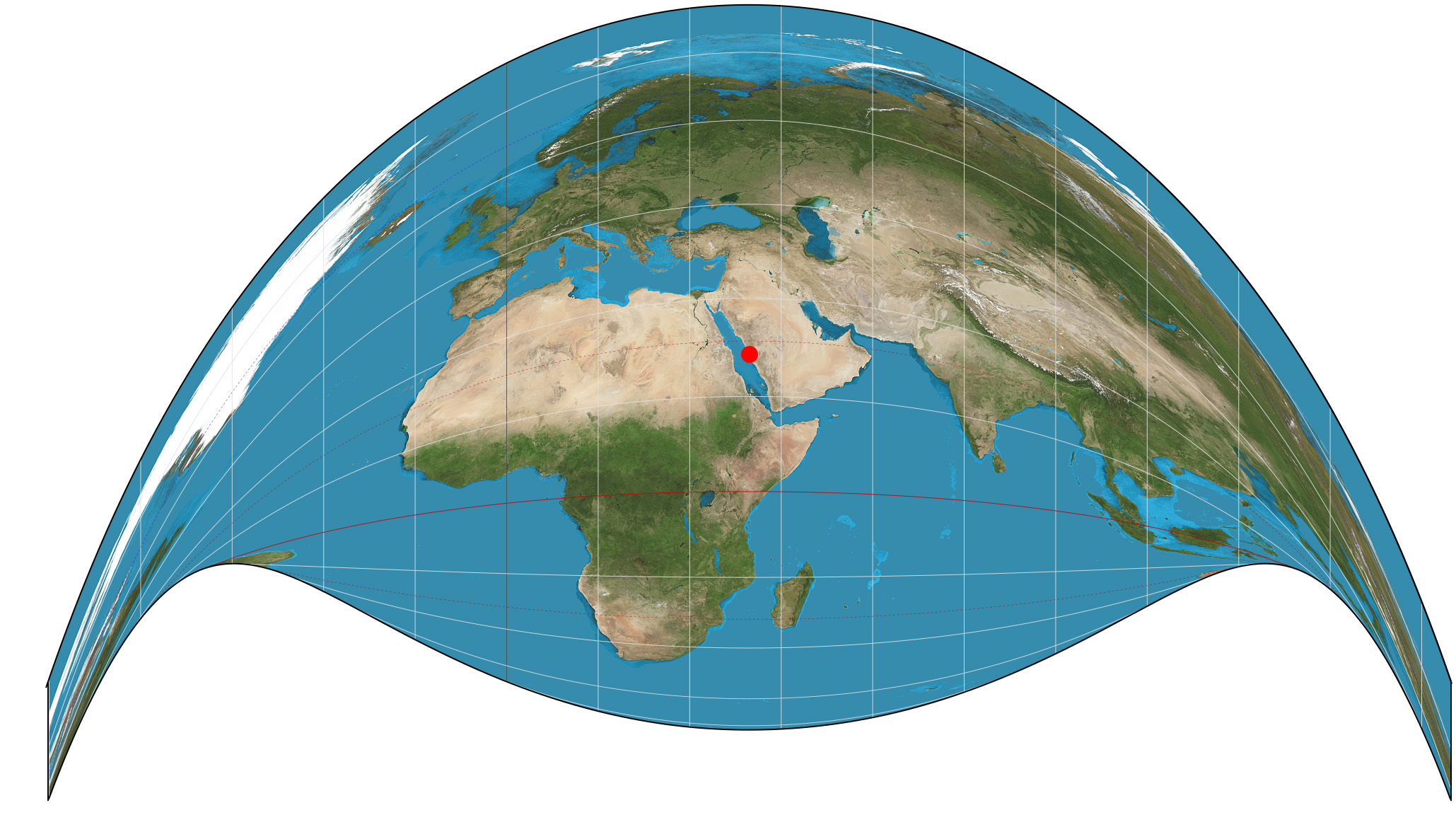] ??? 1. Craig retroazimuthal (planar). 2. Parallel, do not meet at poles. 3. Consider the centerpoint, and why one would wish to know the direction to there from elsewhere. --- ## Gnomonic .image-80[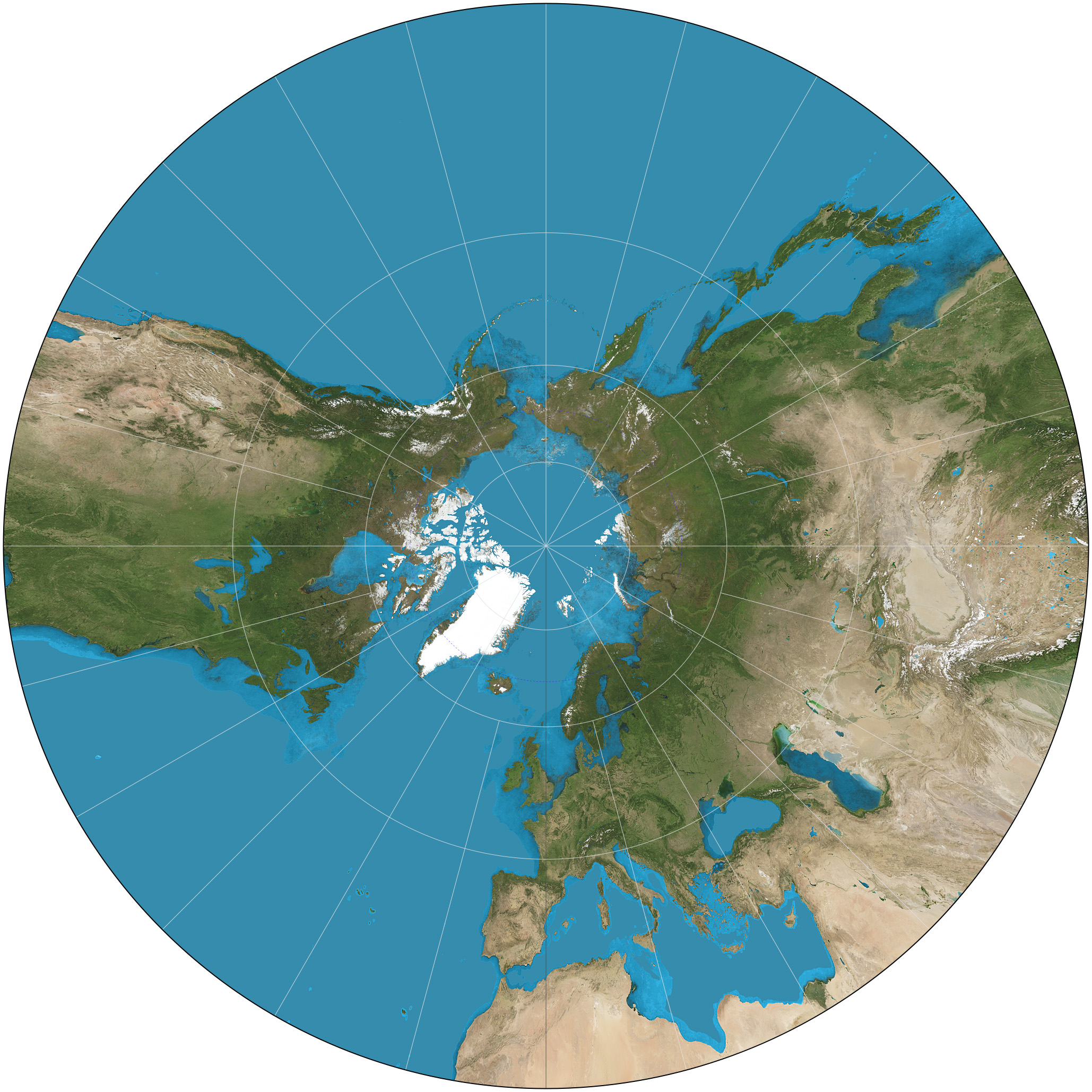] ??? 1. Gnomonic 2. Not parallel, fanning out at equal angles. Meet at visible pole. 3. Useful anywhere you would like to easily see shortest routes. --- ## 'Compromise': Dymaxion/Fuller (icosahedral) .image-90[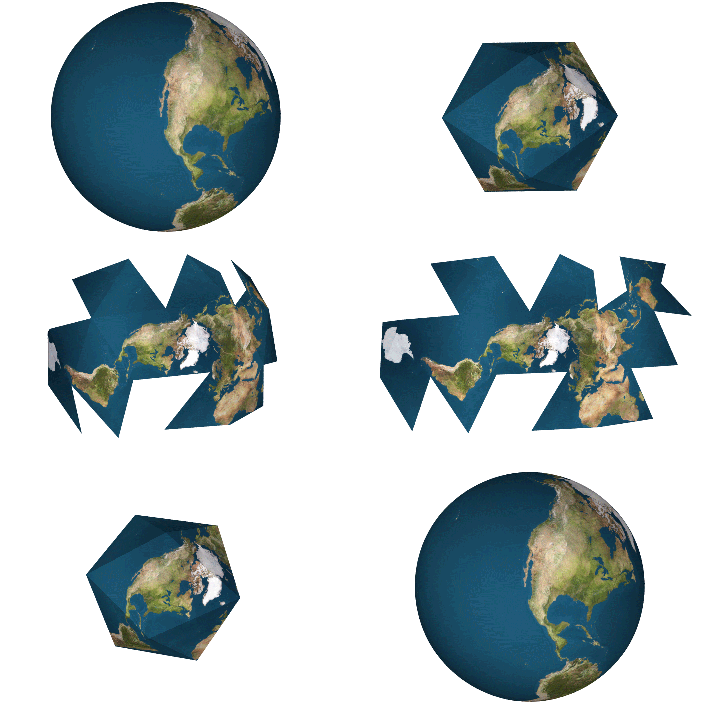] ??? 1. Dymaxion, or Fuller (icosahedron 20-sided polyhedron, then unfolded; sort of planar). 2. Longitudes are doing all sorts of things here. 3. Minimizes area/shape distortion well on each triangle face, allowing for comparison in varied areas on the globe. * I recommend checking out more about Buckminster Fuller; guy was nuts about triangles on shapes. --- ## Relax... It's more likely that you'll be making maps/analysis at more local or regional scale, rather than a world (or even continental scale). * At local scales, most of any distortion is minimal within the working area of the projected coordinate system. * Even using Mercator: have you ever had a problem with distortion with online map services? * Understanding the concepts of projections & coordinate systems can help you avoid pitfalls, but so long as you use appropriate ones to your area of interest, you'll be fine. <!-- https://xkcd.com/977/ http://courses.umass.edu/nrc592g-cschweik/pdfs/Class_3_Georeferencing_concepts.pdf http://lp360.com/newsletter/December2014/December2014_2.html http://desktop.arcgis.com/en/arcmap/10.3/guide-books/map-projections/projection-basics-for-gis-professionals.htm https://en.wikipedia.org/wiki/Map_projection#Projections_by_preservation_of_a_metric_property https://www.nationalgeographic.org/activity/investigating-map-projections/ http://www.progonos.com/furuti/MapProj/Normal/CartProp/cartProp.html -->